Cardiff Sixth Form College > Media > Blogs > News > Engineer Whose Robotic Arm Could Help Keep People Safe in Dangerous Environments celebrates with top A level results
Engineer Whose Robotic Arm Could Help Keep People Safe in Dangerous Environments celebrates with top A level results
Posted: 13th August 2026
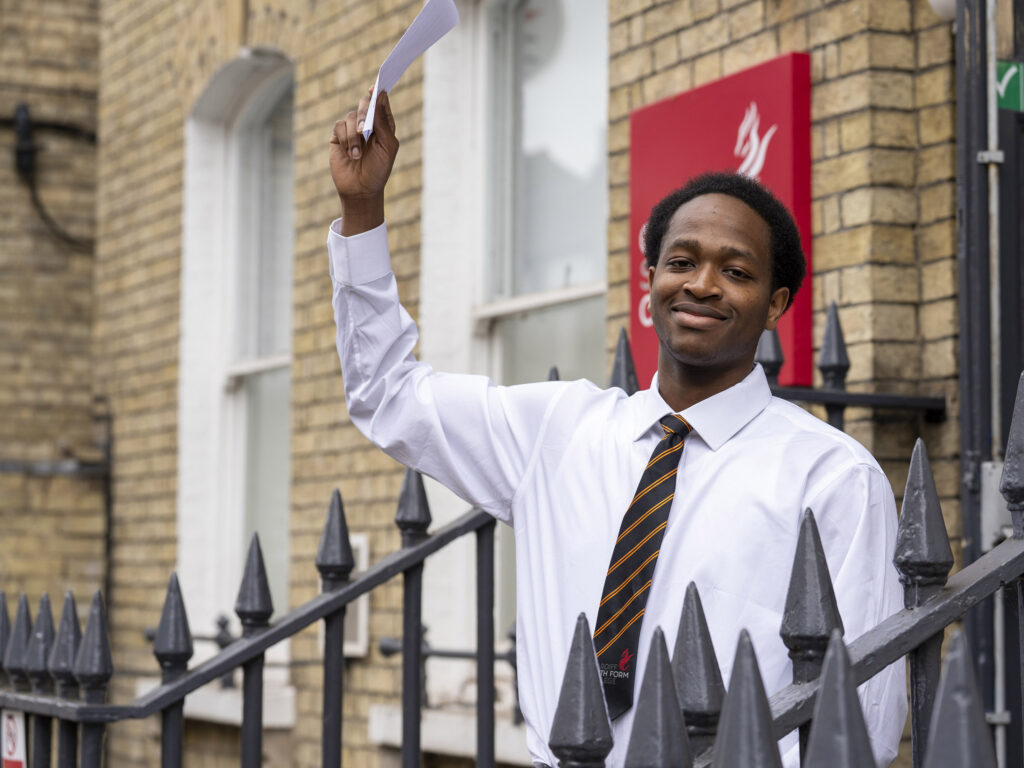
A Cardiff Sixth Form College student from Nigeria who is celebrating his A Level results today gaining an A in Mathematics, A in Physics and a B in Chemistry has developed an innovative robotic arm designed to mimic human hand movements which can potentially operate in hazardous environments.
Emmanuel Ilegar, who is a boarder at Cardiff Sixth Form College in Cambridge has secured a place at the University of Durham to study Electrical and Electronic Engineering. He developed a passion for robotics, culminating in the design and construction of hissophisticated robotic arm that mirrors the movement of a human hand through a glove fitted with sensors.
The project began shortly after he arrived at Cardiff Sixth Form College and discovered the range of practical engineering opportunities available to students.
“In my previous school there weren’t many opportunities to build practical engineering projects,” said Emmanuel. “When I arrived at Cardiff and saw projects that previous students had created, I wanted to challenge myself and build something ambitious.”
Emmanuel taught himself how to programme the arm using C++ and Arduion technology after becoming fascinated by the potential for robotic arms to carry out tasks in environments that may be dangerous for humans. Working in a three-person team, with Emmanuel acting as project lead, he used open-source designs as a starting point before adapting and refining the model to create a functioning prototype.
“I liked the idea of creating something that could eventually be used in situations where it would be unsafe to send a person,” he explained. “If a robotic arm can mirror a human operator’s movements, it opens up possibilities in manufacturing, hazardous environments and many other industries.”
The project involved designing components digitally, 3D-printing the arm, installing motors, wiring and flex sensors, and developing software that enabled the robotic fingers to respond to movements made by the user. Flex sensors were fitted to the glove with each sensor corresponding with a servo motor in the robotic arm which used cables to control the movement of an individual finger.
“The biggest challenge was getting everything to work together,” said Emmanuel. “The strings and cables had to run all the way through the fingers and every component had to be precisely positioned. We went through several rounds of redesigning, coding, debugging and reprinting parts.”
Although the team did not fully achieve all of their original objectives, Emmanuel believes the experience taught him one of the most important lessons in engineering.
“Engineering isn’t always about getting something perfect the first time. It’s about testing ideas, solving problems and improving designs. The project made me even more determined to study engineering and continue developing technologies like this at university.”
The experience reinforced Emmanuel’s desire to pursue a career in engineering and innovation, particularly within the renewable energy sector. Originally from Lagos, he is passionate about improving access to electricity across Nigeria, where many communities continue to experience unreliable power supplies.
“My long-term goal is to work in solar energy and eventually start my own business providing affordable solar technology,” he said. “In many parts of Nigeria, people do not have access to reliable electricity around the clock. I would like to help change that.”
Emmanuel has already gained valuable industry experience through a placement with solar energy company Eauxwell Nigeria Ltd and its subsidiary Solar Shop Ltd. During his work experience, he learned how to simulate solar panel performance, assess annual energy yields, evaluate installation methods and understand different solar technologies available to consumers.
His interest in robotics also led him to compete in the internationally recognised FIRST Tech Challenge, one of the world’s largest robotics competitions for young people.
As Team Captain of a 15-member team, Emmanuel helped design and build a competition robot capable of launching balls into targets within a set timeframe. Team members specialised in coding and design, meeting twice a week while completing intensive training programmes in robotics and engineering.
“Robots are becoming a bigger part of everyday life and it was exciting to be involved in building one from the ground up,” he said.
Outside the classroom, Emmanuel has demonstrated leadership across a wide range of activities. He was a finalist in the prestigious Ritangle mathematics competition and serves as co-leader of the College Running Club, organising training sessions, races and group runs for its members. The club regularly undertakes distances ranging from 5km weekday runs to 14km endurance sessions.
He is also an accomplished musician, holding Grade 5 Piano and regularly performing at college events. During his time at Cardiff Sixth Form College he has appeared in talent shows and performed at assemblies and events across Cambridge.
“Emmanuel is a talented STEM student” said Cardiff Sixth Form College Principal, Dr Julian Davies. “As he prepares to begin the next chapter of his education at Durham, I am sure the lessons learned from building his robotic arm will remain central to his future ambitions and that he will make a significant impact to renewable energy projects in the UK and Nigeria. With strong academic results, practical engineering experience and a clear vision for using technology to address real-world challenges, Emmanuel is well positioned to become part of the next generation of engineers shaping the future.”
“Our robotic arm project showed me what engineering is really about,” said Emmanuel. “You start with an idea, face challenges, solve problems and keep improving. That’s exactly what I want to continue doing throughout my career.”