


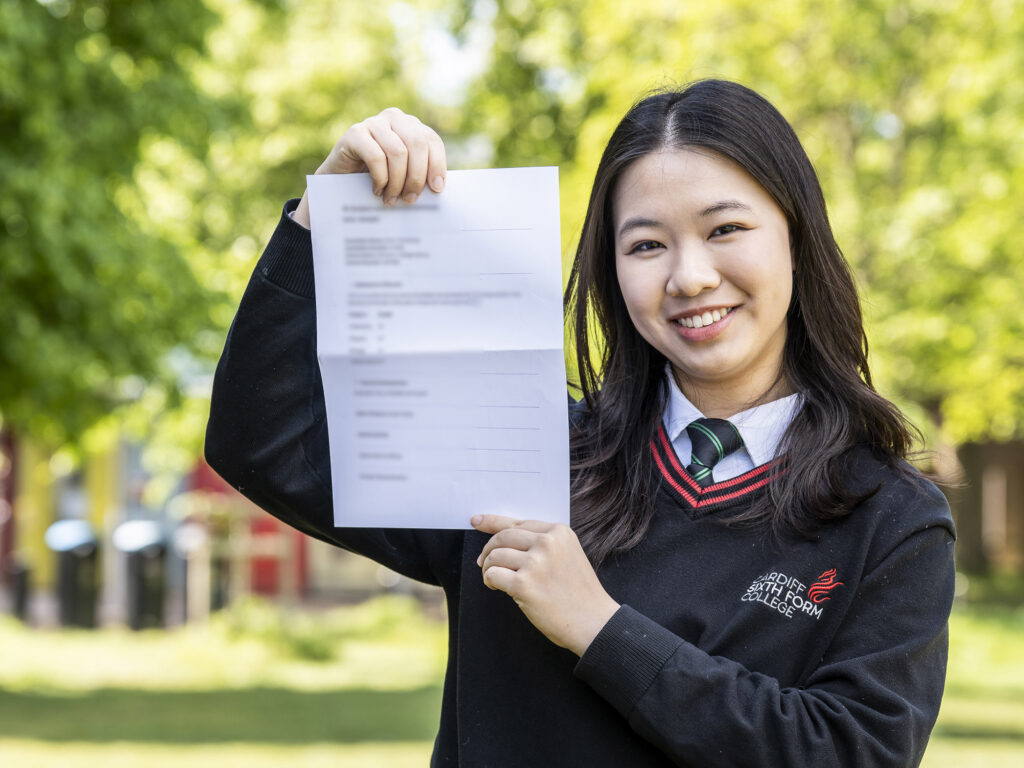
Cardiff Sixth Form College student Renny Lee is celebrating her A-Level results today after securing her place to study Medicine at the University of Liverpool following a remarkable research project into the early detection of a rare and potentially life-changing disease.
Originally from Singapore, Renny studied Biology, Chemistry, Mathematics and Physics(A*, A, A B) while boarding at Cardiff Sixth Form College, a move she says transformed her academic experience.
“I love being at Cardiff Sixth Form College because everyone is so like-minded,” she said. “It’s an incredibly intellectually stimulating environment where people genuinely enjoy learning and discussing ideas.”
That curiosity led Renny to undertake an Extended Project Qualification (EPQ) examining whether Kayser-Fleischer rings can be used as an effective predictor of Wilson’s Disease, a rare inherited disorder that causes copper to accumulate in the body and can lead to severe neurological and liver damage if left untreated.
Her interest in the condition began while shadowing a gastroenterologist in Singapore.
“I saw a wide range of diseases during my placement, but Wilson’s Disease was the one that really stayed with me,” she said. “I became fascinated by the possibility that earlier diagnosis could dramatically improve outcomes for patients.”
Wilson’s Disease prevents the body from properly metabolising copper. One of its most recognisable signs is the appearance of Kayser-Fleischer rings — brown or golden rings around the iris caused by copper deposits in the eye.
However, Renny’s research revealed that the situation is far more complex than it first appears.
“The challenge is that by the time the rings are visible to the naked eye, the disease is often already quite advanced,” she explained. “In the earliest stages they can only be detected using specialist imaging techniques, which many patients do not have access to.”
Her project explored whether wider use of advanced diagnostic methods such as anterior segment optical coherence tomography (AS-OCT) could improve early detection rates.
“I found that early diagnosis is absolutely possible, but access is a major barrier,” she said. “Many people don’t have access to specialist clinics or the technology required to detect the rings at the earliest stages.”
Renny’s research also highlighted the devastating impact of delayed diagnosis.
“If Wilson’s Disease isn’t detected early, copper can accumulate in the brain and nervous system, causing symptoms similar to Parkinson’s Disease,” she explained. “Patients can develop tremors, muscle spasms, movement disorders and progressive neurological decline.”
Her conclusion was that greater awareness and earlier screening could significantly improve patient outcomes.
“I believe these examinations could potentially be incorporated into routine health checks for higher-risk groups,” she said. “A lot of people delay seeking help because they don’t recognise the symptoms. I want people to feel more empowered about their health and understand the value of early diagnosis.”
The project reflects Renny’s broader passion for medicine and patient care, which has been shaped by an extraordinary range of healthcare experiences both in the UK and internationally.
One of the most influential experiences came through a medical outreach trip to Tanzania organised through Cardiff Sixth Form College, Cambridge.
Working in a rural hospital, Renny spent time in paediatric wards, helping healthcare teams care for children and mothers in an environment with extremely limited resources.
“I chose paediatrics because I wanted to work directly with children and families,” she said. “We helped support new mothers with breastfeeding, observed children struggling with respiratory illnesses and looked at the underlying causes of their conditions.”
The experience exposed her to healthcare challenges rarely seen in developed countries.
“There were often three children sharing a single cot and only one nurse covering an entire corridor,” she said. “It really highlighted how much access to healthcare can depend on where you are born.”
During the same trip, she helped establish a triage centre serving members of the Maasai community in rural Tanzania.
“Hundreds of people came to the clinic,” she said. “We helped assess patients, support treatments and provide basic healthcare in areas where access to medical services is extremely limited.”
The experience also exposed her to public health challenges including HIV awareness and healthcare education.
One patient encounter in particular left a lasting impression.
“There was a child with aplastic anaemia who needed a bone marrow transplant,” she recalled. “The only suitable donor was in India and the family couldn’t afford the treatment. There was no realistic care pathway available and he was receiving palliative care.”
“It was heartbreaking, but it taught me an important lesson. Medicine isn’t always about curing people. Sometimes it’s about supporting patients and families through incredibly difficult circumstances.”
Renny has also undertaken extensive healthcare experience closer to home.
While studying in the UK, she travelled every Saturday to West Suffolk Hospital in Bury St Edmunds, often leaving at 7am, to gain additional clinical exposure.
Working on a diabetes ward, she spoke with patients and observed healthcare teams caring for those living with long-term conditions.
She also completed a public health internship with Abbott, the global healthcare company responsible for developing the Panbio COVID-19 testing kit.
The placement explored nutritional science, healthcare marketing, manufacturing processes and infant nutrition.
“It was fascinating to see healthcare from a completely different perspective,” she said. “Medicine isn’t only about doctors and hospitals. Public health and industry also play a huge role in improving lives.”
Beyond medicine, Renny has made a significant contribution to College life.
She served as President of the Music Society, playing piano, guitar and singing while organising performances at Christmas events, assemblies and art showcases.
As a member of the Debating Society, she helped Cardiff Sixth Form College achieve third place overall at the UCL Winter Cup Debate.
She also edits and coordinates the College newsletter, encouraging students to write about topics they are passionate about and emerging developments within their chosen fields.
Her leadership experience extends to student government, where she helped organise major events including a Summer Ball hosted at Westminster College, Cambridge, and fundraising events such as an International Women’s Day seminar featuring Cambridge University researchers and graduates.
Academically, she achieved a Gold Award in the British Biology Olympiad and volunteers at the Whipple Museum, supporting events and engaging with visiting academics and specialists.
Reflecting on her journey from Singapore to Cambridge, Renny says the experience has reinforced her determination to pursue medicine.
“Medicine is incredibly competitive in Singapore and opportunities are limited,” she said. “Coming to Cambridge gave me the chance to explore my interests in greater depth, undertake research and gain experiences that confirmed this is the career I want.”
Said Cardiff Sixth Form College Cambridge Principal, Dr Julian Davies: “Renny has made an outstanding contribution to the community at Cardiff Sixth Form College. As well as achieving academically excellent results, an incredible research paper and taking part in our international citizenship experience to Tanzania she has been part of the music society, debating society and won many academic Olympiads. She will make an excellent doctor in the future.”
As she celebrates her A-Level results and prepares to begin medical school at Liverpool, Renny hopes to continue combining scientific research with compassionate patient care.
“My EPQ taught me how important early diagnosis can be,” she said. “My experiences with patients have shown me the human side of medicine. Ultimately, that’s what motivates me most — helping people live healthier and better lives.”
Categories: News