Cambridge-bound Cardiff student develops Alzheimer’s app inspired by MIT research
Posted: 13th August 2026
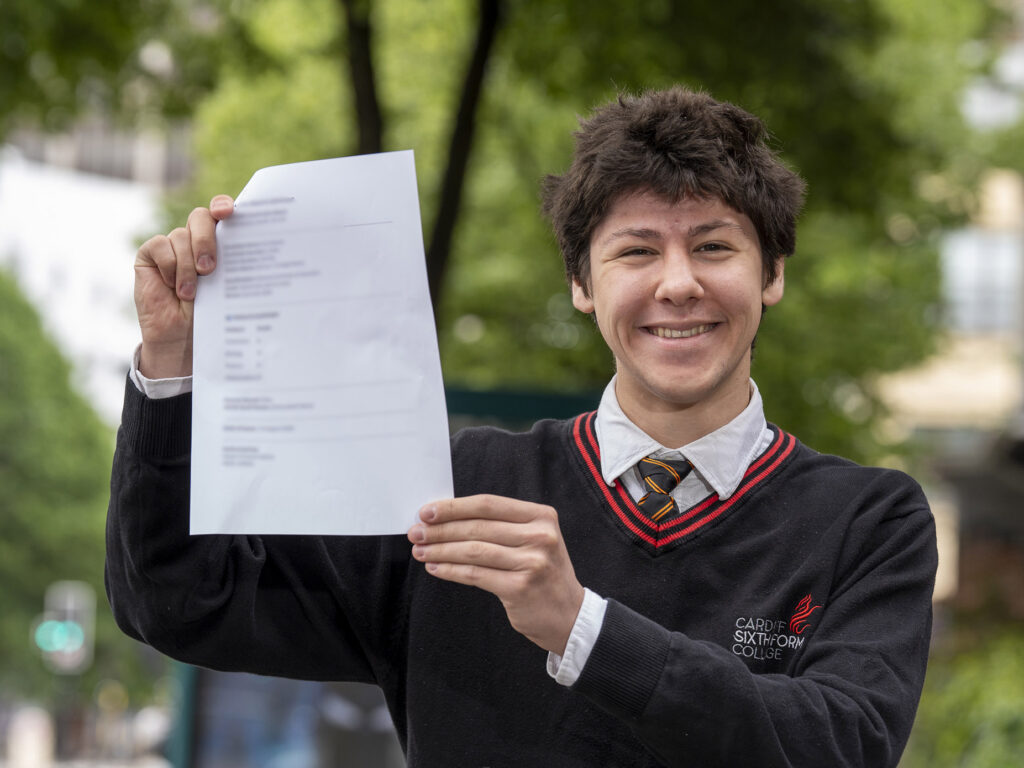
Cardiff Sixth Form College student Aleksei (Alex) Medvedev is celebrating A-Level Results Day after securing his place to study Natural Sciences at Trinity College, Cambridge, while already establishing an impressive record in neuroscience research, healthcare innovation, scientific publishing, elite sport and community volunteering.
Alex, who studied Physics, Chemistry, Mathematics and Biology, achieved four A*s plus an A in his EPQ and will take up a place at Cambridge University, where he plans to explore the emerging intersection between physics, neuroscience and computer interfaces.
His passion for science has led him far beyond the classroom. Most notably, Alex has spent the past two years developing a Non-Invasive Alzheimer’s Treatment App with fellow Cardiff Sixth Form College student Vitaly.
The project was inspired by research from the Massachusetts Institute of Technology (MIT) investigating the effects of 40Hz sensory stimulation on Alzheimer’s disease. Studies have suggested that stimulation at this frequency may influence biological processes associated with the disease and potentially help alleviate symptoms.
“I became interested in Alzheimer’s because it affects so many people and families, yet many treatments can be expensive or inaccessible,” said Alex. “I wanted to explore whether there could be a non-invasive and affordable approach that could be made available to more people.”
Drawing upon his growing interest in cellular neuroscience, Alex designed the biological and scientific elements of the project while his co-founder developed the software infrastructure.
The app combines visual and audio stimulation. It also utilises binaural beats, the technology which allows one to achieve a similar reduction in symptoms at much higher frequencies of sound. Alex introduced the audio component after recognising that many elderly patients experience hearing difficulties and may benefit from an alternative form of sensory stimulation.
The project attracted attention from Imperial College Health Partners, which connected Alex with researchers, clinicians and university partners working in healthcare innovation. Through this network, he attended a conference at King’s College London, meeting researchers and doctoral students working on related areas of neuroscience and dementia research.
In a particularly significant development, Alex and his colleague secured a meeting with the MIT professor whose original research inspired the project.
“We had the opportunity to discuss our work directly with the researcher who conducted the original study,” said Alex. “He suggested several improvements to our design, which we subsequently incorporated into the app.”
The application is publicly available but has not yet undergone clinical testing. Alex and his team have explored potential investment opportunities to fund future clinical trials, although funding has not yet been secured.
Alongside his work in neuroscience, Alex has built an impressive research portfolio.
His Extended Project Qualification explored Neuroscience and the Psychology of Emotions, while independent reading and laboratory experience gradually shifted his interests towards cellular neuroscience.
“At first I was fascinated by how the brain influences behaviour and emotion,” he explained. “The more research papers I read, the more interested I became in understanding how those processes occur at a cellular level. The transition from studying the brain as a whole to studying individual cells is what really captured my attention.”
Alex has also undertaken cognitive neuroscience research at the Institute for Cognitive Neuroscience at the Higher School of Economics in Moscow. Working in an electroencephalography (EEG) laboratory, he investigated how readers allocate attention to different words whilst listening to a text.
Using EEG equipment capable of monitoring brain activity while participants carefully listen, the research explored whether word length influences attention and information retention, with potential applications in education, communication and learning. He is currently preparing the findings for publication.
His scientific interests extend into plant biology. Alex recently became a published author in the Russian Journal of Biological Invasions following research examining plant hormones and growth responses. Through fieldwork and experimental studies, he demonstrated how plants alter their growth direction after pruning by modifying hormone distribution within plant tissues.
In addition to his independent research, Alex completed an internship with EG Many Labs, an international neuroscience collaboration involving researchers from Leeds and Sheffield. During the placement he analysed scientific data, supported website development and helped improve research communication materials.
Despite his extensive academic commitments, Alex has remained deeply engaged in community service. Every Sunday he cycles to Grange Pavilion in Grangetown, where he volunteers for three to four hours teaching STEM subjects to approximately 30 to 40 pupils from local schools.
“I enjoy helping younger students discover science and mathematics,” he said. “STEM subjects can open so many opportunities and it’s rewarding to help build confidence in children who may not otherwise have access to additional support.”
At Cardiff Sixth Form College, Alex also serves as a prefect and played a key role in organising the school’s TEDx programme. He helped interview applicants and select the final eight speakers from a pool of 62 candidates.
Away from academia, Alex competes at a high level in volleyball. He represented Wales in the UK championship internationally and plays semi-professionally in the National Volleyball League Division Two alongside fellow Cardiff Sixth Form College students.
Alex credits much of his scientific curiosity to the support he has received from his family and teachers.
“My mother is an economist and my father is an engineer, so I’ve always grown up around analytical thinking,” he said. “More recently, my physics teacher at Cardiff Sixth Form College, Mr Kampas, inspired a much deeper interest in physics, which is now one of the areas I hope to pursue further at Cambridge.”
Looking ahead to his studies at Trinity College, Cambridge, Alex hopes to contribute to cutting-edge research in biophysics, neuroscience and brain-computer interfaces.
“The convergence of physics, biology and neuroscience is one of the most exciting areas of science today,” he said. “I would like to contribute to research that helps us better understand the brain and ultimately improve people’s lives.”